Hallway Storage Units: A Beginner's Guide to Sizes, Styles and Shoe Capacity
Hallways are the hardest working space in the house and usually the smallest. They collect shoes, coats, keys, post, dog leads and the odd school bag. A storage unit can turn that chaos into something calm, but only if it fits the space and the job. This guide walks through the three decisions that matter most: depth, height and shoe capacity.
Measure the hallway before you look at units
Start with a tape measure and a roll of masking tape. Mark the footprint you have in mind on the floor, then walk past it. If you have to turn sideways, the unit is too deep. Leave a clear walkway that feels comfortable for your household; for most people, 80–100 cm is easy, while 70 cm is tight but workable if you only pass single file. If you use a pushchair or wheelchair in the hallway, measure the turning space and aim for more.
Check the things that are easy to forget: door swings, radiator clearances, plug sockets, light switches, skirting boards and awkward alcoves. A unit that blocks a radiator wastes heat, and one that covers a socket means moving furniture to plug in a vacuum. Measure the full height from floor to ceiling too. In a narrow hallway, going tall is often smarter than going wide.
Write the numbers down and take them shopping with you, in centimetres and saved on your phone. Shop-bought units are listed by their outer dimensions, not the usable space inside, so a cabinet described as 40 cm deep may only give you 34 cm once the doors and back panel are counted. If you are buying online, look for the internal shelf depth in the specifications rather than trusting the photograph. A surprisingly common mistake is ordering a unit that fits the wall perfectly but leaves the front door unable to open fully — so open and close every nearby door at least once while your tape marks are still on the floor.
Depth: the measurement that decides what fits
Depth is the number people overlook, and it causes the most disappointment. A beautiful unit that is 20 cm deep will not take a pair of adult boots. A 60 cm deep wardrobe will swallow coats, but it may also swallow your walkway. Decide what the unit must hold before you fall for a finish.
A quick depth guide
- 20–25 cm: slim shoe cabinets, keys, post, small baskets and folded gloves.
- 30–35 cm: most adult shoes, including trainers and flat boots, plus folded bags.
- 40–45 cm: larger trainers, tall boots, storage boxes and bulky items.
- 60 cm: hanging coats and jackets on standard hangers.
If you need both shoes and coats in a tight hallway, consider a 35 cm deep shoe cabinet with a row of coat hooks above it. The hooks do not need depth, and the cabinet keeps the floor clear. If you have the space, a 60 cm deep combination unit gives you hanging space on one side and shoe shelves on the other.
Angled or tilted shoe shelves are worth knowing about, too. They hold shoes heel-down so you can see every pair at a glance, and they can work in a 30 cm deep unit because each shoe sits at a slant. The drawback is that they suit flat shoes and trainers far better than tall boots, which need upright space. If your household is mostly boots, a deeper flat shelf will serve you better.
Height: low benches, mid-height cabinets and tall towers
Height changes how a hallway feels and how much it holds. A low unit, around 45–50 cm high, works as a bench with shoe storage underneath. It gives you somewhere to sit while tying laces, and it keeps the top of the hallway open. A mid-height unit, roughly 90–120 cm, adds drawers and a shelf for keys, but it can become a dumping ground if you do not give each item a home.
Tall units, from 180 cm up to ceiling height, offer the most storage per square centimetre of floor. They suit narrow hallways because they use vertical space that would otherwise be empty. The trade-off is visual weight. A tall, dark unit in a small hallway can feel like a wall. Light colours, glass or mirrored doors, and open gaps at the top can soften the effect. If you choose a tall unit, secure it to the wall, especially in homes with children or pets.
Think about the top shelf as well. Anything above roughly 180 cm is out of comfortable reach for many adults and impossible for children, so keep it for once-a-season items: wellington boots, beach bags, spare bulbs, the Christmas box. The shelves you use every day should sit between knee and shoulder height, where you can grab a pair of shoes without bending or stretching.
Styles, doors and finishes that work in a hallway
Built-in units make the best use of awkward alcoves and uneven walls. A joiner can scribe the unit to the skirting and fill the gap to the ceiling, which looks intentional and leaves no dusty crevices. Freestanding units are easier to move and cheaper to change, but they rarely fit a space perfectly. Modular systems sit somewhere in between: you buy a frame and add shoe drawers, baskets, shelves or a bench as needed.
Door style matters more than you might think. Hinged doors need room to swing, which is a problem in a narrow corridor; sliding doors solve that but need a clear track and a firm, straight wall. Open shelving keeps everything visible and lets damp shoes dry faster, but it also shows every stray sock and unopened bill. A mix often works best: closed cabinets at the bottom for shoes, open hooks and a shallow shelf above for the things you grab on the way out.
For finishes, pale greys, off-whites and light woods bounce light around a dark hallway, while matt surfaces hide fingerprints better than high gloss. If your hallway is short on natural light, a mirror fitted to a cabinet door doubles as a last-minute check before you leave the house — and makes the space feel wider than it is.
Shoe capacity: how many pairs will it really hold?
Manufacturers love to quote generous figures, so it pays to do your own rough maths. A standard adult shoe takes up roughly 25–30 cm of shelf length per pair when placed side by side. That means a 100 cm wide shelf holds about three to four pairs, not the six or seven a glossy product photo might suggest.
A few rules of thumb help:
- Count pairs, not people. A family of four can easily own thirty pairs between them once trainers, school shoes, boots and wellingtons are included.
- Double up with a two-tier shelf. Splitting a 40 cm deep shelf into two shallow levels lets you stack one pair above another, nearly doubling capacity for low shoes.
- Keep boots separate. Tall boots need height, not width, so give them one dedicated column or the top of a tall unit.
- Allow for growth. Children's shoes change size twice a year, so leave a little spare room rather than filling every shelf to the brim.
Try this before you buy: lay your family's shoes out on the floor in rows the width of the unit you are considering. If the pile overflows the tape, the unit will too.
Materials, upkeep and a quick fitting checklist
Hallways take punishment. They are the first place wet shoes land, where bags are dropped and doors are knocked. Choose materials that can cope: sealed wood or laminate wipes clean, powder-coated metal resists scuffs, and painted MDF is affordable but dents easily. Avoid unfinished timber on floor-level shelves unless you enjoy water rings, and put a washable tray or mat under the shoe zone to catch grit and drips.
Before you commit, run through this short list:
- Measure the opening, the wall, the ceiling height and the walkway — twice.
- List what the unit must hold and how many pairs of shoes that means.
- Check door swings, sockets, radiators and skirting boards.
- Confirm the unit can be secured to the wall if it is tall.
- Decide who assembles it, and whether you need a joiner for a built-in.
Get those five points right and the hallway stops being a dumping ground. It becomes the calm, tidy space you walk through twice a day without really noticing — which is exactly what good storage should do.
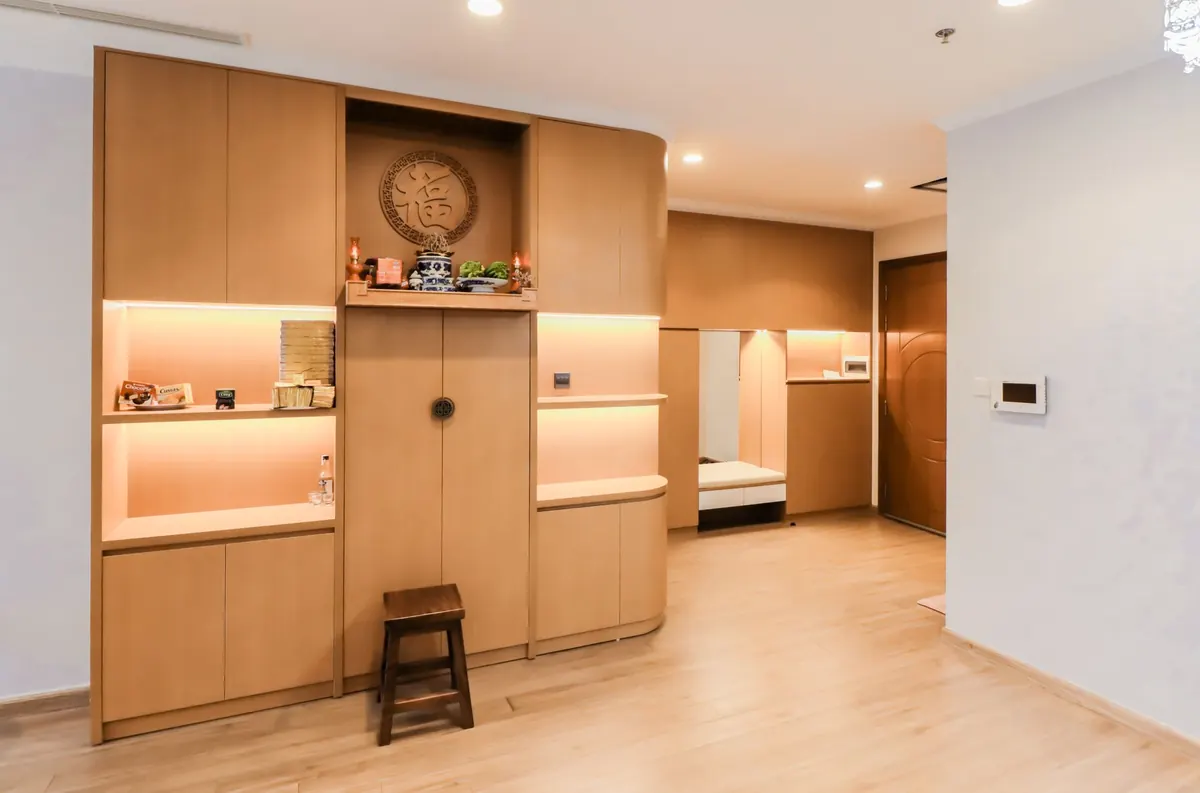
Photo: DOAN THANH BINH / Pexels