Built-In vs Freestanding Bookcases: Which Suits a Small UK Living Room?
A small living room asks a lot of a bookcase. It has to hold the books, the records, the board games and the things that have no other home, without crowding the sofa or blocking the light. Freestanding units and built-in joinery solve that problem in genuinely different ways: one trades permanence for flexibility, the other trades flexibility for space. Neither is the better answer in every room. Here is how to work out which one yours is asking for.
Space: what each option really costs you
A freestanding bookcase is usually around 80cm wide and 30cm deep, and however carefully you place it, it will not sit flush to the wall. Allow a few centimetres behind and beside for skirting boards, lumps of plaster and the simple difficulty of pushing furniture into a corner. Two or three units later, those gaps have eaten floor space — the scarcest thing in a compact room. In a 3m by 4m living room, three 80cm units with 5cm gaps at each side and behind will quietly consume almost half a square metre of floor you could otherwise walk on.
What freestanding shelving leaves you is the space above it. That matters if you have a low window, a radiator, a picture rail, or a room where a tall unit would cut the light in half. You keep the airy top half of the wall and lose only the footprint. A low unit under a window, for example, can hold paperbacks and a lamp without touching the view.
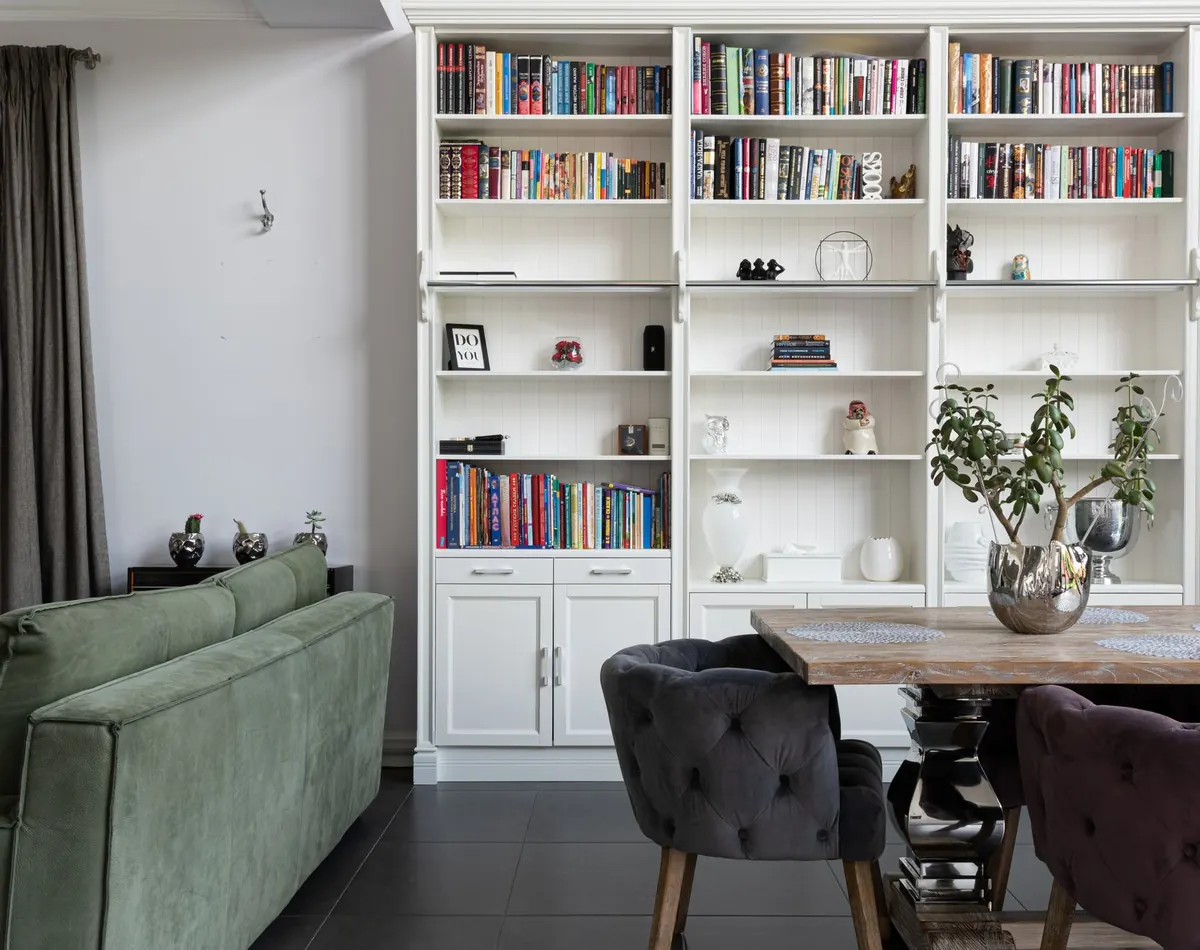
Built-in shelving does the opposite. It takes an awkward slice of wall — an alcove beside a chimney breast, the return beside a door — and fills it floor to ceiling. In a period terrace, a shelf run from just above the skirting to near the ceiling gives you roughly two metres of vertical storage in a space that was previously holding a lamp and a wilting plant. Furniture cannot give you that, and in a room where every wall is contested, it often settles the question. The same is true of the shallow recess beside a chimney breast: 30cm deep, 1.2m wide, and useless for a sofa, but perfect for a full-height run of shelves.
Cost: what you are actually paying for
Freestanding is the cheaper route by a wide margin, and the only one that lets you start small and add later. A flat-pack unit, a solid wood piece from a house clearance, or a mid-range retail bookcase will all do the job without anyone arriving with a van of tools. You can buy a decent 80cm bookcase for £60–£150, and if it lasts five years before you move it on, it has earned its keep.
Built-in joinery costs more because you are paying for work flat-pack cannot do. The money goes into:
- Materials. Paint-grade MDF and plywood are affordable; veneered board and solid timber are not.
- Measuring and design. Someone has to work out shelf spacing before anything is cut. With a joiner, that time is in the quote.
- Fitting. Alcove walls are rarely square, so shelves need scribing — cut and shaped to follow the wall — and notching around skirting, cornice and uneven ceilings.
- Finishing. Priming, sanding and two or three coats of paint take longer than the building, and show more.
- Hardware. Adjustable shelf pins, hinges and door fittings if you want clutter hidden.
Joiners usually quote by the linear metre, so measure your alcove width before asking for a figure. A simple alcove unit might start around £300–£500 per linear metre in MDF, painted; hardwood and bespoke details push it well beyond that. If you want alcove shelving rather than full cabinets, cutting timber to size and painting it yourself is a genuine middle option: simpler than joinery, far cheaper than a fitted commission, and forgiving of an imperfect wall.
Rule of thumb: if the quote is more than the value the room gains in usable space, freestanding is probably the smarter buy.
Style: two very different effects in a small room
Built-in shelving reads as part of the architecture. Painted the same colour as the walls — including the inside of the shelves — it visually recedes and makes a small room feel calmer. Painted in a stronger colour, it becomes the focal point and the walls can stay quiet. One decision governs the whole look. This is why colour drenching works so well with alcove shelves: when shelf, wall and skirting are all the same shade, the eye stops noticing the edges and the room feels wider.
Height matters as well. A tall, narrow run of shelves draws the eye upwards and makes a low ceiling feel less oppressive. A long horizontal run stretches the room sideways, which is usually the more useful trick in a narrow living room.
Freestanding units bring a looser character: informal, easy to rearrange, and easy to get wrong. Mixed heights and finishes make a small room feel cluttered quickly. A single run of same-height units in one finish reads far more calmly. Keep shelves shallow where you can — 25cm is generous for most paperbacks and hardbacks — and remember that if you store A4 folders or art books you will need at least 32cm between shelves.
Flexibility, and the long game
Freestanding wins on adaptability. You can move it, repaint it, split it in two, take it to the next house. If you rent, that matters twice over: fitted shelving generally becomes a gift to the property, and you may need your landlord's permission before fixing anything to the wall. Even if you own, the next owner may not share your taste in full-height alcove units, and a room that feels bespoke to you can feel like a project to someone else.
Built-in shelving, by contrast, is a commitment. It is harder to remove without making good the wall, and it locks you into a layout. But that permanence is also its advantage: it will not wobble, it will not be left behind, and it can be designed around the exact awkward shape of your room. If you plan to stay put for five years or more, the maths usually shifts in its favour.
Renting, moving and the resale question
If you rent, think carefully before drilling. Many tenancy agreements require written permission for wall fixings, and even then you may be expected to return the wall to its original state at the end of the term. A tall freestanding unit, anchored with a safety strap to a stud or a heavy piece of furniture, gives you most of the storage without the argument. If you own and plan to sell, built-in shelving can add perceived value in a period property — but only if it is well made and painted neatly. A badly fitted unit is worse than no unit at all.
Practical checks before you commit
Whichever route you choose, measure twice and check these before you buy or book a joiner:
- Ceiling height. A built-in that stops 10cm short of the ceiling looks like a mistake; one that runs into cornice needs careful scribing.
- Skirting depth. If your skirting is 15cm deep, a freestanding unit will stand proud of the wall. Built-ins can be notched around it.
- Radiators and sockets. Shelves in front of a radiator block heat; shelves in front of a socket make it useless. Plan around both.
- Light switches and door swings. A unit that blocks a switch or catches a door will annoy you daily.
- Weight. Books are heavy. A full-height run of shelves can weigh several hundred kilograms, so fixings must go into studs or masonry, not plasterboard alone.
A middle path: semi-fitted and modular options
You do not have to choose between a flat-pack unit and a full joinery commission. Modular systems — often sold as alcove kits or adjustable wall-mounted rails — let you create a fitted look without the bespoke price. Some are designed to be cut down to fit your space, and many can be painted to match the walls. A joiner-built carcass with adjustable shelves is another sensible compromise: the expensive part is the fitting and finishing, so doing the painting yourself can save a significant sum.
If the alcove is shallow, open shelving on simple brackets is the cheapest built-in look of all. It gives you the floor-to-ceiling storage without the cabinet doors, and in a small room the lack of bulk often feels lighter. Just be honest about clutter: open shelves demand more tidiness than closed cabinets.
In the end, the question is not which is better, but which suits the room you have. If you need every centimetre and you are staying put, built-in joinery earns its cost. If you need flexibility, hate waste, or might move, freestanding lets you change your mind. Most small UK living rooms can make a good case for either — and a surprising number end up with a hybrid: one fitted run in the awkward alcove, one freestanding unit where the wall is too precious to drill.
Photo: Max Vakhtbovych / Pexels